Vietnam Travel Guide 2026
Ha Long Bay, Hoi An, Hanoi, Sapa & Beyond
Vietnam has become one of the fastest-rising international destinations for Indian travellers. In the first eleven months of 2025 alone, 656,000 Indians visited. This guide explains why — and tells you everything you need to plan a trip that actually lives up to what you've heard.
There is a moment on a Ha Long Bay overnight cruise — somewhere around 6am, when the mist is still sitting on the water between the limestone karsts, and the only sound is the boat's gentle movement — when Vietnam stops being a travel destination and becomes something else. Something more difficult to describe. The country has a quality of concentrated beauty that feels almost deliberate, as if the landscape were arranged by someone who knew exactly what they were doing.
Indian travellers have been discovering this in large and growing numbers. The 656,000 who visited in the first eleven months of 2025 represent a 30% increase on the year before, driven by an e-Visa process that takes 3 business days and USD 25, direct or one-stop flights from every major Indian city, and a currency exchange rate that makes even mid-range Vietnam feel remarkably affordable by Indian standards. 1 INR equals approximately 286 Vietnamese Dong — which means the mental arithmetic of budgeting in Vietnam has a pleasing extra zero on all the local prices.
"Vietnam is not just beautiful. It is beautiful in a way that surprises you — because no photograph quite prepares you for the scale of Ha Long Bay, the smell of Hoi An's night market, or the noise and energy of Hanoi's Old Quarter at 7am."
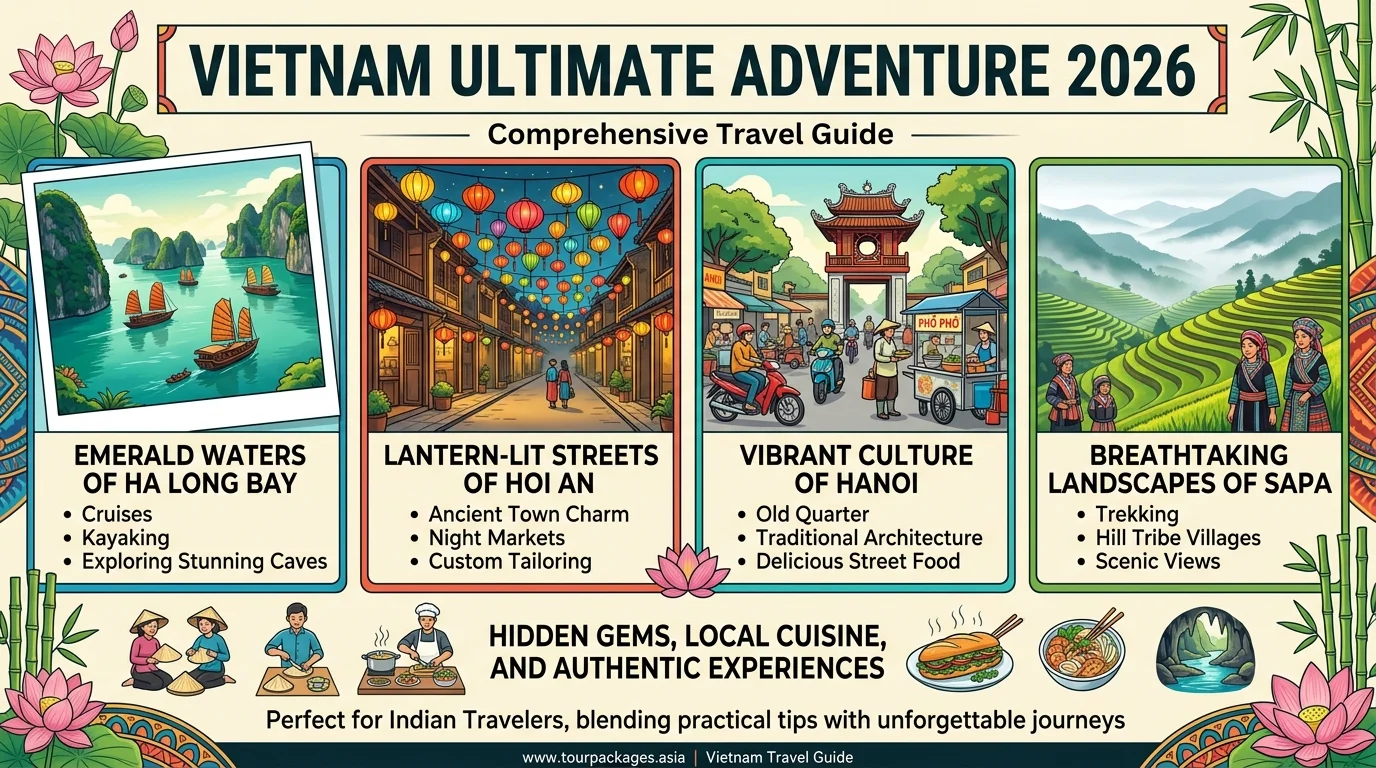
This guide covers the seven destinations that define a well-planned Vietnam trip for Indian travellers — from the limestone karsts of Ha Long Bay to the rice terraces of Sapa, from the lantern-lit streets of Hoi An to the war history of Ho Chi Minh City. It also covers the practical logistics that actually matter: the e-Visa step-by-step, realistic costs in INR, vegetarian food navigation, 7-day and 10-day itinerary structures, and the specific things worth booking in advance versus leaving spontaneous. Our Asia travel guide archive covers companion destinations across Southeast Asia for multi-country circuit planning.
Why Vietnam Works So Well for Indian Travellers
Three things distinguish Vietnam from comparable Southeast Asian destinations in 2026 for Indian travellers. First, the value: the exchange rate makes a quality mid-range hotel room (INR 2,500-4,500 per night) and an outstanding restaurant meal (INR 600-1,500 for two) accessible at a price point that would buy considerably less in Thailand or Singapore. Second, the variety: a country the length of Italy that compresses four entirely different climate zones, landscapes, and cultural traditions into a single continuous itinerary — mountain rice terraces in the north, imperial history in the centre, colonial-era architecture in the south. Third, the food: Vietnamese cuisine is one of Asia's most distinctive and health-forward food traditions, built around fresh herbs, light broths, rice-based preparations, and minimal oil — which suits the Indian palate considerably better than the heavier, saltier food traditions of some neighbouring countries.
The Vietnam e-Visa for Indian passport holders is one of the most straightforward international entry processes available. Applied online at evisa.xuatnhapcanh.gov.vn: USD 25, valid for 90 days from issue, permits a stay of up to 90 days, processed in 3 business days. Required: a passport valid for at least 6 months beyond your planned departure from Vietnam, a digital passport photograph, and your accommodation address for the first night. The e-Visa replaced the earlier letter-based visa-on-arrival system for Indian passport holders in 2023 and is now the standard and reliable entry method. Apply before purchasing flights — the e-Visa is issued within 3 days but occasionally takes longer during peak periods.
Seven Best Places to Visit in Vietnam for Indian Travellers 2026
These seven destinations cover the essential length of Vietnam — from the Hanoi capital in the north to Ho Chi Minh City in the south — and together form the backbone of every well-designed Vietnam itinerary for Indian travellers.
Hanoi is one of Southeast Asia's most atmospheric capitals — not because it is the most polished or the most modern, but because it has retained a quality of lived-in density that the region's more sanitised cities have lost. The Old Quarter's 36 streets (each historically associated with a different trade — Silk Street, Tin Street, Paper Street) form a maze of narrow lanes where motorbikes, market stalls, and street food vendors occupy every available centimetre of space at every hour of the day. Walking it at 7am — when the city is mid-breakfast and the pho stalls are doing their peak business — is one of Asia's most vivid urban experiences.
Egg Coffee (Ca Phe Trung) — invented at Cafe Giang near the Old Quarter in 1946 as a wartime substitute for milk — is a Hanoi speciality that has no real equivalent anywhere else: Vietnamese robusta coffee with a whipped egg yolk and condensed milk foam that creates something halfway between a coffee and a dessert. Hoan Kiem Lake at the centre of the city is where Hanoians gather for morning exercise, evening strolls, and impromptu badminton games. The water puppet theatre at Thang Long (a uniquely Vietnamese art form in which wooden puppets perform on water to live traditional music) runs evening shows that are genuinely extraordinary for anyone who has not seen it before. Budget: INR 1,800-3,500 per night for mid-range heritage hotels in the Old Quarter area. Allow 2 full days minimum before a Ha Long Bay departure.
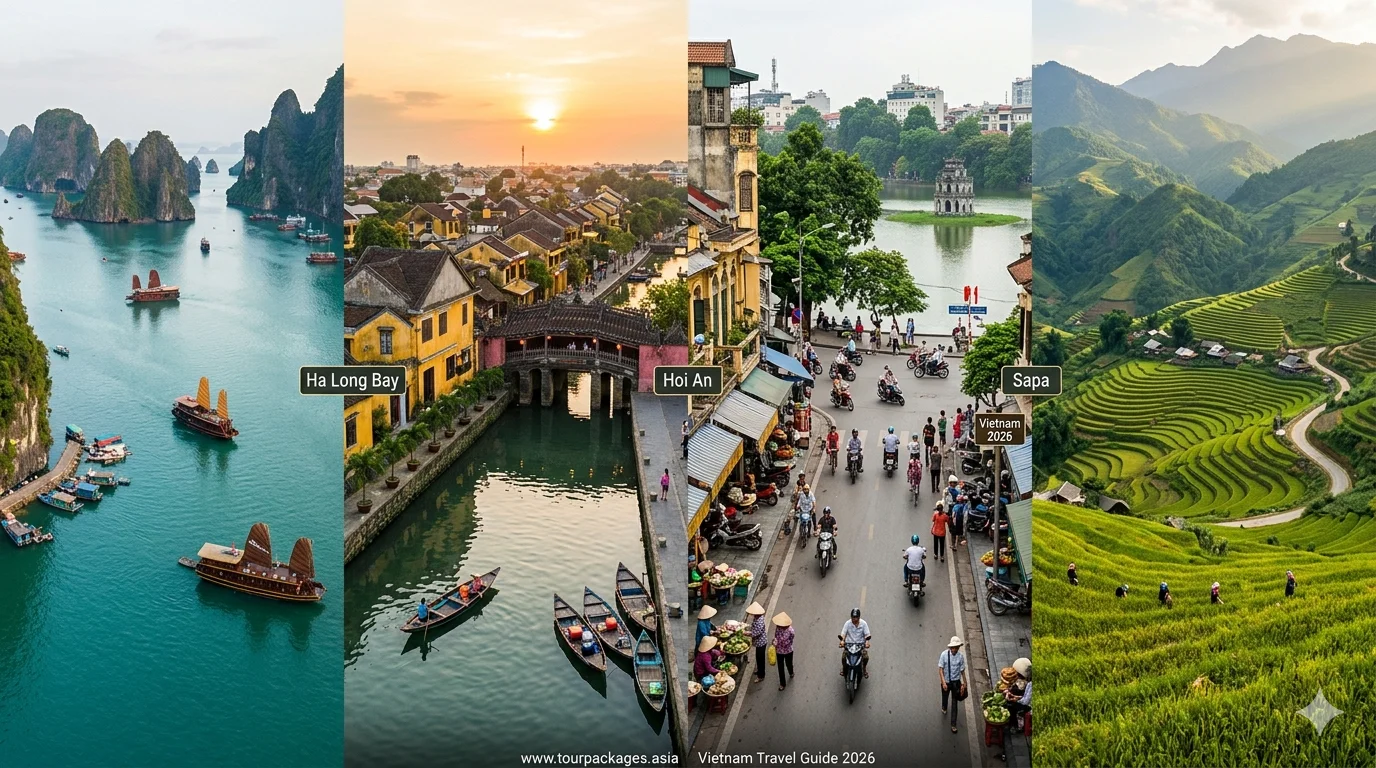
Ha Long Bay is what happens when 1,600 limestone karst pillars — some over 100 metres tall — rise from 1,500 square kilometres of emerald water in the Gulf of Tonkin. The word "dramatic" barely covers it. The scale is the thing that photographs cannot prepare you for: emerging from your cabin at 6am to find the boat surrounded by vertical rock walls covered in jungle, with mist sitting in the hollows between them and the water completely still, is an experience that has genuinely moved people to unexpected emotion. This is not an overstatement — it is a common traveller report from Ha Long Bay.
The cruise is the only way to experience Ha Long Bay properly. Day trips cover the bay but the overnight cruise (2 nights, 3 days) allows access to Bai Tu Long Bay (adjacent to Ha Long, fewer tour boats, identical beauty) and Lan Ha Bay (accessed from Cat Ba Island, even fewer boats, excellent sea kayaking through narrow limestone passages). For Indian travellers, a mid-range cruise (USD 140-250 per person, INR 12,000-21,000) is the right tier — the cabins are comfortable, the food is excellent (Vietnamese seafood prepared on board), and the on-board activities (kayaking, cave exploration, cooking demonstrations, swimming at secluded beaches) are the same as luxury cruises. Book at least 2-4 weeks ahead in peak season (October-April) — the best mid-range operators fill quickly. Avoid budget junk cruises under USD 60 per person — some have structural safety concerns and poor food quality that significantly affect the experience.
Hoi An Ancient Town is one of those places that has been genuinely preserved rather than reconstructed — the yellow-painted merchant houses with their wooden-shuttered windows, the Japanese Covered Bridge at the western end of the town (built in the 1590s and continuously occupied since), the riverside lantern sellers, and the evening market atmosphere when the electric lights are switched off and hundreds of silk lanterns illuminate the streets — all of this is the actual historical fabric of a 15th-17th century trading port, maintained by a community that still lives and works in it. Walking its lanes at different times of day — 6am when vendors set up, noon when the light is harsh and the streets are almost empty, 7pm when the lanterns come on and the river fills with candlelit boats — reveals three entirely different experiences of the same town.
The Full Moon Lantern Festival (held on the 14th of every lunar month — the night before the full moon, when the town turns off its electricity and switches entirely to candlelight and silk lanterns) is one of Vietnam's most genuinely beautiful recurring events and worth timing your trip around if you can. Hoi An's tailor street (Tran Phu and Le Loi streets in the ancient town area) produces custom-made clothing in 24-48 hours at prices that are a fraction of boutique equivalents — shirts from USD 15, dresses from USD 25, suits from USD 80. Quality varies; ask your hotel for trusted tailors they have used themselves rather than walking into shops on spec. The Southeast Asia travel guides on our blog include detailed Hoi An itinerary resources.
Da Nang is the transit hub for Central Vietnam — its international airport (connected to major Indian cities via Bangkok or Kuala Lumpur) is 30 minutes from Hoi An and 3 hours from Hue, making it the logical base for the central Vietnam segment of any itinerary. The city itself has 30 kilometres of coastline, with My Khe Beach and Non Nuoc Beach providing long stretches of good swimming and pleasant resort-scale accommodation. The Dragon Bridge (fire-breathing on weekend evenings — a genuinely fun spectacle) and the Han River bridges are Da Nang's urban landmarks.
Ba Na Hills — a French colonial-era hill station developed into a large entertainment complex at 1,487 metres — is home to the Golden Bridge, the pedestrian walkway appearing to be held up by giant stone hands, set against mountain mist and valley views, that became Vietnam's most internationally shared photograph after going viral globally. The cable car approach (5.8 km, among the world's longest non-stop cable car rides) is itself spectacular. A full Ba Na Hills day — cable car, Golden Bridge, French Village, Fantasy Park, cable car return — costs USD 35-45 per person and is worth it for the visual spectacle and the cloud-forest atmosphere at the summit, even if the theme park elements are not particularly compelling. Visit early morning (mist lifts between 8-10am) for the best conditions.
Sapa is what the Himalayan foothills would look like if they were covered in stepped rice terraces descending to valley floors where small villages of H'mong, Dao, Tay, and Giay ethnic minority communities have lived and farmed for centuries. At 1,500 metres in the Hoang Lien Son range near the Chinese border, the landscape has a dramatic vertical quality — terraces cut into steep hillsides at angles that seem structurally impossible, catching the light differently at every hour of the day. In September and October, when the rice is mature and golden, the terraces photograph unlike anywhere else in Asia.
The trekking ranges from easy village walks (2-3 hours, accessible to all fitness levels) to the Fansipan summit at 3,143 metres — Indochina's highest peak, reachable by cable car (20 minutes from Sapa town, extraordinary views) or by a 2-day technical trek (recommended only for serious trekkers with experienced guides). For most Indian travellers, a 2-day itinerary of valley village walks with a local H'mong guide (who typically walks the route in flip-flops that make every visiting tourist feel appropriately humbled), a stay in a village homestay, and a sunrise cable car to the Fansipan viewing platform covers the essential Sapa experience. The overnight train from Hanoi to Lao Cai (the railhead for Sapa, 8 hours, INR 500-1,500 for a berth) is a much better experience than the tourist bus and worth taking at least in one direction. See our adventure travel guides for Sapa trek planning resources.
Ho Chi Minh City — still called Saigon by virtually everyone who lives there — is Vietnam's largest and most commercially intense city. The energy is different from Hanoi: faster, more international, less historically weighted, with a skyline that has changed more dramatically in the past 20 years than almost any comparable Asian city. The French Quarter (District 1) still has its colonial-era boulevards, the Notre-Dame Cathedral, and the Central Post Office — grand 19th-century buildings that look astonishing in the context of the surrounding 21st-century commercial chaos.
The Cu Chi Tunnels — 250 kilometres of underground tunnels, hospitals, kitchens, weapons factories, and living quarters built by Viet Cong fighters during the American War — are 70 kilometres from the city centre and among the most genuinely moving historical sites in Southeast Asia. Visitors can enter a widened section of the original tunnels (100 metres, dark, narrow — intense but manageable for most adults), see the ventilation systems disguised as termite mounds, and the trap door entrances camouflaged in the forest floor. The War Remnants Museum in District 3 — which documents the war from the Vietnamese civilian perspective, with photographs from international photojournalists including several Pulitzer Prize winners — is essential visiting for any traveller who wants to understand what the country has come from. A half-day Cu Chi Tunnels plus afternoon War Remnants Museum combination (INR 2,500-4,000 for the guided day tour, museum entry included) is the most efficient structure. The Mekong Delta day trip from Ho Chi Minh City — canal boats through coconut palm orchards, floating market visits, honey bee farm stops — adds one more dimension to the south Vietnam experience.
Phu Quoc is Vietnam's premier beach destination — a large island in the Gulf of Thailand with white sand beaches on its western coast, resort-standard accommodation at every price point, and a relaxed atmosphere that is the right counterpoint to the cultural and historical intensity of a Vietnam itinerary that has included Hanoi, Ha Long Bay, Hoi An, and Ho Chi Minh City. Long Beach on the west coast has the island's calmest swimming water and faces the Gulf of Thailand for the sunset — which at Phu Quoc, with the low horizon and the sky colouring without obstruction, is reliably extraordinary.
Phu Quoc's own airport (Phu Quoc International) has direct connections to Ho Chi Minh City (55 minutes, multiple daily flights), Hanoi (2 hours), and several international destinations. This makes it the ideal final stop before flying home — flying Hanoi to Ho Chi Minh City on your last full travel day, spending 2-3 nights on Phu Quoc, then flying home from the island directly. The snorkelling around the An Thoi archipelago in the southern tip of Phu Quoc — clear water, coral reef, excellent marine life including rays, turtles, and reef sharks — is the island's best water experience and runs as a full-day boat trip for approximately INR 1,500-2,500 per person. Avoid visiting Phu Quoc during the wet season (May-October) when monsoon conditions make the western beaches rough and the water less clear.
Vietnam Itinerary: 7 Days and 10 Days for Indian Travellers
These two structures represent the most effective way to organise a Vietnam trip from India. The 7-day itinerary focuses on the essential north-south highlights. The 10-day version adds Sapa for mountain depth and Phu Quoc for beach resolution.
7-Day Vietnam Itinerary from India (Essential Highlights)
Day 1: Arrive Hanoi (Noi Bai Airport). Check in to Old Quarter hotel. Evening walk through Hoan Kiem Lake and the 36 streets. Egg Coffee at Cafe Giang. Water puppet show at Thang Long Theatre.
Day 2: Full Hanoi day — Ho Chi Minh Mausoleum area in the morning, Old Quarter lanes and street food in the afternoon. Evening free for Temple of Literature or Hoan Kiem lakeside.
Day 3-4: Ha Long Bay 2-day/1-night overnight cruise (depart 8am from Hanoi by road transfer, board cruise at Ha Long pier by noon, return to Hanoi by 5pm Day 4). Kayaking, cave exploration, swimming, sunset on deck, breakfast on the bay.
Day 5: Domestic flight Hanoi to Da Nang (1.5 hours). Transfer to Hoi An (30 minutes). Afternoon and evening in the Ancient Town — first lantern experience, riverside dinner.
Day 6: Full Hoi An day — cooking class morning, tailor appointment (order pickup arranged for same evening), Cam Kim Island bicycle ride in the afternoon, Full Moon Festival if dates align.
Day 7: Morning flight Da Nang to Ho Chi Minh City (1.5 hours). Cu Chi Tunnels half-day tour. War Remnants Museum. Depart or overnight for next day departure.
10-Day Vietnam Itinerary from India (Full Country Experience)
Days 1-2: Hanoi (as above). Day 3-4: Ha Long Bay 2-night 3-day cruise (add Bai Tu Long Bay extension for Days 2-3). Day 5-6: Sapa — overnight train from Hanoi to Lao Cai on Day 5 evening, arrive Sapa morning of Day 6, valley trek and village homestay, Fansipan cable car Day 7 morning. Day 7: Return from Sapa by bus to Hanoi, evening domestic flight Hanoi to Da Nang. Day 8: Ba Na Hills and Golden Bridge full day. Day 9: Hoi An Ancient Town, cooking class, tailor. Day 10: Fly Da Nang to Phu Quoc (via HCMC), beach resort check-in, Long Beach sunset. Optional: 2-3 nights Phu Quoc extension before departure.
Essential Planning Tips for Your Vietnam Trip from India
Click each panel for targeted planning advice — covering e-Visa, packing, getting around, food, and money — everything first-time Indian travellers to Vietnam need to know before departure.
Vietnam e-Visa: Step-by-Step for Indian Passport Holders
- Apply at the official portal only: evisa.xuatnhapcanh.gov.vn — this is the Vietnamese Immigration Department's official e-Visa platform. Avoid third-party agents who charge INR 2,000-5,000 for the same service that costs USD 25 on the official site. Third-party applications sometimes contain errors that cause entry problems.
- Documents required: Indian passport valid for at least 6 months after your planned Vietnam departure date; digital passport photo (white background, face clearly visible, taken within 6 months); your proposed entry and exit dates; address of your first night's accommodation. That is the complete requirement.
- Cost and processing: USD 25 per person, payable by international debit or credit card. Processing takes 3 business days — apply before purchasing flights to ensure approval before committing to non-refundable tickets. Print or save the approved e-Visa electronically and carry it at all times in Vietnam.
- Validity structure: The e-Visa is valid for 90 days from the date of issue and permits a stay of up to 90 days. This means you can enter and exit Vietnam multiple times within the 90-day window, which is useful for multi-country Southeast Asia circuits combining Vietnam with Cambodia, Laos, or Thailand.
- At the airport: Present your e-Visa printout (or electronic copy on your phone) at the immigration counter alongside your passport. Vietnamese immigration officers are straightforward — have your hotel booking confirmation and return ticket available if asked, though these are not always requested.
- Tour Packages Asia assists with e-Visa documentation verification as part of all Vietnam itinerary packages. Contact us via the enquiry form on this page or via our planning service.
What to Pack for Vietnam — Indian Traveller Edition
- Clothing for climate diversity: Vietnam spans three climate zones. Pack light cotton and linen for the south and coast (Phu Quoc, HCMC, Da Nang — tropical, humid, 28-34°C). Add a mid-layer for Ha Long Bay evenings (cool on the water at night) and a warm jacket and thermal layer for Sapa (1,500m altitude, cool to cold depending on season — can drop below 10°C in winter).
- Footwear: Comfortable walking sandals for Hanoi and Hoi An street walking; closed-toe shoes with grip for Sapa trekking (the rice terrace paths are muddy and steep in wet conditions — sandals are inadequate and potentially dangerous); flip-flops for Phu Quoc beach. Three pairs covers all situations.
- Rain protection: A compact packable rain jacket is essential in Central Vietnam (Hoi An and Hue rain heavily September-November) and in Sapa (rain can arrive any time, the mist creates persistent dampness). A small waterproof day bag cover protects electronics and documents during afternoon showers.
- Mosquito repellent: DEET-based repellent (30%+ concentration) is essential for evening outdoor activities — Mekong Delta, Sapa village walks, Hoi An night market. Malaria risk in Vietnam is low in tourist areas but dengue is present — long sleeves and repellent at dusk is sensible standard practice.
- Medications: Carry a basic travel pharmacy — oral rehydration salts (spicy Vietnamese food at street level occasionally causes temporary digestive upset in first-time visitors), antihistamine, antifungal cream for humid coast areas, and any prescription medications with a doctor's letter for customs. Pharmacies in major Vietnamese cities are well-stocked and affordable.
- Electronics: Vietnam uses the same plug type as India (Type A/C/G) so adaptors are not essential, though a universal travel adaptor is useful for rural guesthouses. A portable charger is essential for long Ha Long Bay cruise days when cabin charging access is limited.
How to Get Around Vietnam — Transport for Indian Travellers
- Domestic flights — the right choice for long distances: VietJet Air, Bamboo Airways, and Vietnam Airlines operate multiple daily flights on the Hanoi–Da Nang–Ho Chi Minh City axis. Fares booked 4-8 weeks ahead: USD 20-70 per segment (INR 1,700-6,000). Flying saves 30+ hours versus train for the full north-south journey. Book via the airlines directly or through flight comparison platforms.
- Grab app — essential for cities: Download Grab (Southeast Asia's ride-hailing equivalent of Ola with GPS tracking) before arriving. Works in Hanoi, HCMC, Da Nang, Hoi An, and all major cities. Eliminates meter taxi overcharging — the single most common tourist complaint in Vietnam. Share your Grab ride status to your group before the car moves.
- Ha Long Bay and Sapa — organised transfers: Ha Long Bay cruises include round-trip transfers from Hanoi hotels. Sapa is reached by overnight train (Hanoi Tran Quy Cap station to Lao Cai, 8-hour journey, INR 500-1,500 for a berth in a 4-berth cabin) or by tourist bus (5-6 hours, less comfortable, no scenic value). Train is strongly preferred.
- Hoi An — walk and cycle: Hoi An Ancient Town is pedestrianised in the evenings and small enough to walk completely. Cycling to Cam Kim Island (15 minutes from the town centre across the Thu Bon River) is one of the most pleasant ways to spend a morning — bicycles are available for hire from almost every guesthouse for INR 100-200 per day.
- Motorbike rental — for experienced riders only: Vietnam's city traffic — particularly HCMC — is genuinely challenging for visitors unaccustomed to the flow patterns. Motorbike rental is popular among experienced Southeast Asia backpackers but is not recommended for Indian travellers without prior Vietnam or Thailand riding experience. Grab is safer, cheaper, and faster in cities.
Food in Vietnam — Guide for Indian Travellers and Vegetarians
- The must-eat list: Pho (pronounced 'fuh') at a local street stall at 7am — this is Vietnam's national dish and the version served at a busy neighbourhood stall is substantially better than at tourist restaurants. Banh Mi from a street cart — a baguette sandwich with pate, vegetables, chilli sauce, and herbs that costs INR 30-80 and is one of the world's great street foods. Bun Cha in Hanoi — grilled pork in sweet-savoury dipping broth with vermicelli and a plate of fresh herbs. Cao Lau in Hoi An — thick noodles specific to this town, using water from one of Hoi An's ancient wells for the noodle production. Egg Coffee in Hanoi.
- For vegetarians: Vietnam has a significant Buddhist vegetarian tradition. Com Chay (vegetarian rice) restaurants operate in most cities, particularly near pagodas — these serve tofu, vegetable dishes, mushroom-based mock meats, and fresh spring rolls. Hoi An has multiple dedicated vegan and vegetarian restaurants. Request "khong thit, khong ca" (no meat, no fish) at regular restaurants — useful for soup and fresh spring roll orders.
- Fish sauce navigation: Most Vietnamese dishes use nuoc mam (fish sauce) as a base flavouring — including many broths that appear vegetarian. For strict vegetarians, Com Chay restaurants are the safest option. At regular restaurants, specifically request "khong nuoc mam" (no fish sauce) for fresh salads and spring rolls — most will accommodate this. Broth-based dishes are more difficult to adapt.
- Street food safety: Vietnamese street food is generally safe when eaten at busy, popular stalls with high turnover — the same selection logic that applies in India. Fruit, Banh Mi, Pho, and fresh spring rolls at busy stalls are consistently safe options for first-time visitors. Drink bottled water and avoid ice outside of established restaurants and cafes.
- Indian food availability: Indian restaurants operate in Hanoi (Old Quarter area), HCMC (Bui Vien and Pham Ngu Lao areas), and Hoi An — useful for homesick palates mid-trip, though most Indian travellers report that Vietnamese food is comfortably manageable from the first day, particularly for those accustomed to South Indian and coastal Indian cuisines which share Vietnam's affinity for fresh herbs, rice, and seafood.
Money, Safety and Practical Tips for Vietnam
- Currency and exchange: Vietnamese Dong (VND). 1 INR = approximately 286 VND as of April 2026. USD is widely accepted at hotels, restaurants, and major tourist attractions — carrying a small USD reserve (USD 100-200) alongside VND covers most contingencies. Exchange INR to USD in India before departure (better rates than direct INR-VND exchange) and convert USD to VND at Vietnamese airport exchange counters or city banks on arrival. ATMs dispense VND and accept international Visa and Mastercard — a reliable fallback.
- Grab app for city transport (repeat emphasis — critical): Overcharging by metered taxis at tourist areas is Vietnam's most common minor traveller problem. Grab eliminates it entirely. Download before arrival. Keep mobile data active (a Vietnamese SIM card from the airport — approximately INR 300-500 for 15 days unlimited data — is the most reliable solution).
- Safety: Vietnam is consistently one of Southeast Asia's safest destinations for international tourists. Violent crime against visitors is rare. Primary caution: bag-snatching from motorbikes in HCMC street areas (keep bags on the building-side of pavements, not the road-side). At Ha Long Bay, follow all crew safety instructions on the cruise — some guests have been injured by unsupervised kayak excursions in bad weather conditions.
- Haggling: Expected in markets (Ben Thanh in HCMC, Night Market in Hoi An, Dong Xuan in Hanoi) and for non-metered services. Not appropriate in restaurants, air-conditioned shops, or for Grab rides. Hoi An tailors have posted prices — these are negotiable by approximately 10-20% on larger orders. Start at 50% of the asking price in markets and meet in the middle.
- Photography etiquette: Ask before photographing Vietnamese people directly — particularly ethnic minority communities in Sapa, where extensive unasked photography has created a documented tension between tourism income and cultural dignity. A simple gesture asking permission is universally understood and appreciated. Government buildings, military installations, and border areas: do not photograph.
Frequently Asked Questions: Vietnam from India 2026
Every question Indian travellers ask before their first (or second) Vietnam trip — answered with the practical detail that actually helps you plan.
Yes. Indian nationals require a visa for Vietnam. The most convenient option is the Vietnam e-Visa, applied online at the official Immigration Department portal. Cost: USD 25. Validity: 90 days from issue. Permitted stay: up to 90 days. Processing: 3 business days. Required: passport valid 6+ months, digital passport photo, entry/exit dates, and accommodation address. Apply before purchasing flights.
It depends on which region you prioritise. For all regions in one trip: March to April is the best overall window. For North Vietnam (Hanoi, Ha Long Bay, Sapa): October to April. For Central Vietnam (Hoi An, Hue, Da Nang): February to April and July to August. For South Vietnam (HCMC, Phu Quoc): December to April. For Sapa harvest season (golden rice terraces): September to October.
Budget traveller (hostels, street food): INR 55,000-75,000 per person for 7 days including flights. Mid-range (3-star hotels, restaurant meals, organised tours): INR 90,000-1,30,000 per person. Boutique/comfortable (heritage hotels, Ha Long Bay luxury cruise): INR 1,50,000-2,50,000 per person for 8-10 days. Flights from India add INR 18,000-35,000 return. The exchange rate (1 INR ≈ 286 VND) makes Vietnam genuinely affordable.
Ha Long Bay is best experienced on a 2-night overnight cruise — this allows access to less-visited Bai Tu Long Bay and Lan Ha Bay. Budget junk cruises (USD 60-100 per person) have structural concerns — avoid. Mid-range cruises (USD 140-250, INR 12,000-21,000 per person) are the right tier — comfortable cabins, excellent Vietnamese seafood, kayaking, cave exploration. Luxury (USD 300-600+) for premium comfort. Book 2-4 weeks ahead in October-April peak season.
Yes — Hoi An is consistently ranked one of the most beautiful small towns in Asia. Allow 2 nights and 2 full days: walk the yellow-walled ancient town at different times of day, take a cooking class, order custom clothes from a trusted tailor (24-48 hours, extraordinary value), cycle to Cam Kim Island rice paddies, attend the Full Moon Lantern Festival if your dates align (14th of every lunar month, one of Asia's most beautiful recurring events). The cooking class is strongly recommended — it changes how you understand Vietnamese food fundamentally.
Domestic flight is the correct choice for most travellers — 2 hours, USD 20-70 (INR 1,700-6,000) on VietJet, Bamboo, or Vietnam Airlines when booked in advance. The full Hanoi-HCMC train takes 33-36 hours (beautiful but impractical for time-limited trips). Take the train for shorter scenic segments — Da Nang to Hue (2.5 hours, spectacular coastal views) or the overnight train Hanoi to Lao Cai for Sapa (8 hours, INR 500-1,500, much better experience than the tourist bus).
Pho (rice noodle soup, INR 60-200 at street stalls, extraordinary at 7am). Banh Mi (Vietnamese baguette sandwich, INR 30-80, one of the world's great street foods). Bun Cha in Hanoi (grilled pork in dipping broth with noodles). Cao Lau in Hoi An (thick noodles specific to this one town). Egg Coffee (Ca Phe Trung) in Hanoi. For vegetarians: Com Chay (Buddhist vegetarian rice restaurants), fresh spring rolls (Goi Cuon), tofu dishes. Indian restaurants operate in all major cities for familiar alternatives.
Sapa is worth including for travellers who want Vietnam's most dramatic natural landscape — stepped rice terraces at 1,500 metres among H'mong and Dao ethnic minority villages. Best months: September-October (golden harvest terraces) and March-May (blossom, mild). Trekking ranges from easy village walks (2-3 hours) to Fansipan summit (3,143m — cable car in 20 minutes or 2-day trek). Take the overnight train from Hanoi (8 hours, INR 500-1,500) — significantly better than the tourist bus. Adds 2-3 days to a 7-day itinerary.
Vietnam is consistently one of Southeast Asia's safest destinations for international tourists. Violent crime against visitors is rare. Primary caution: bag-snatching from motorbikes in HCMC street areas (keep bags on the building side of pavements). Use Grab ride-hailing app instead of metered taxis to eliminate overcharging. Solo women travel Vietnam successfully and comfortably in large numbers. Eat at busy stalls with high turnover. Drink bottled water.
Phu Quoc Island — white sand, clear water, Gulf of Thailand sunsets, own airport. Best November-April. Da Nang — My Khe and Non Nuoc beaches, 30 minutes from Hoi An, excellent for combining beach with culture. Best May-August. Nha Trang — most developed resort town, good for water sports and diving. Con Dao Islands — offbeat, excellent diving, sea turtle nesting, accessible from HCMC. Quy Nhon — central Vietnam, beautiful beaches with almost no tourism.
The Mekong Delta — narrow canals through coconut palm orchards, floating markets, river islands, wooden sampan boats — is entirely different from anything else in Vietnam. Day trips from HCMC cover Ben Tre province (INR 1,500-2,500 per person, 2-3 hours each way). An overnight stay in Can Tho is better — it allows a 5am visit to Cai Rang floating market (the largest in the delta, extraordinary at dawn). Strongly recommended as an addition to any HCMC visit of 3+ days.
The Golden Bridge — a pedestrian walkway appearing to be held by giant stone hands, set against mountain mist at 1,487 metres above Da Nang — is one of Vietnam's most photographed images. The cable car approach (5.8 km, among the world's longest non-stop cable car rides) is itself spectacular. Full Ba Na Hills day (cable car, Golden Bridge, French Village, Fantasy Park) costs USD 35-45 per person (INR 3,000-3,800) and takes a full day. Visit early morning — mist typically lifts between 8-10am. Yes, it is worth it for the photographs and the cloud-forest atmosphere.
The Cu Chi Tunnels are 250 km of underground tunnels, hospitals, kitchens, and weapons factories built by Viet Cong fighters during the Vietnam War, 70 km from HCMC. Visitors enter a widened section (100m, dark, narrow — intense but manageable), see ventilation systems disguised as termite mounds, and original booby trap displays. Combined with the War Remnants Museum in HCMC (Pulitzer Prize-winning war photography), this is the most significant historical experience in South Vietnam. Cost: INR 2,500-4,000 for a guided day tour from HCMC.
Yes, better than most Indian travellers expect. Com Chay (Buddhist vegetarian rice restaurants) operate in most cities. Hoi An has multiple dedicated vegan and vegetarian restaurants. Fresh spring rolls (Goi Cuon), tofu dishes, and fruit are universally available. The challenge: most Vietnamese dishes use fish sauce (nuoc mam) as base flavouring. Request "khong nuoc mam" (no fish sauce) for salads and spring rolls. For strict vegetarians and Jains, Com Chay restaurants are the safest choice. Indian restaurants operate in Hanoi, HCMC, and Hoi An for familiar alternatives.
Tour Packages Asia designs Vietnam itineraries for Indian travellers specifically — factoring in vegetarian dietary preferences, flights from Hyderabad, Bengaluru, Mumbai, and Delhi, and accommodation in centrally located heritage properties. Our packages include Ha Long Bay cruise bookings at the right tier, Hoi An tailor introductions at trusted establishments, Hanoi cooking class bookings, Sapa trek arrangements with licensed H'mong guides, and e-Visa documentation verification. Revelation Holidays designs bespoke high-end Vietnam itineraries with private guiding and curated boutique property selection. WhatsApp: +91 91009 84920.
Plan Your Vietnam Trip
Tell us your travel dates, departure city, interests, and budget. Our Vietnam specialist will respond within 24 hours with a personalised itinerary and cost breakdown in INR. e-Visa documentation assistance included for all package bookings.
WhatsApp: +91 91009 84920Your information is used only to plan your trip. We do not share personal data with third parties.
Questions and Comments